
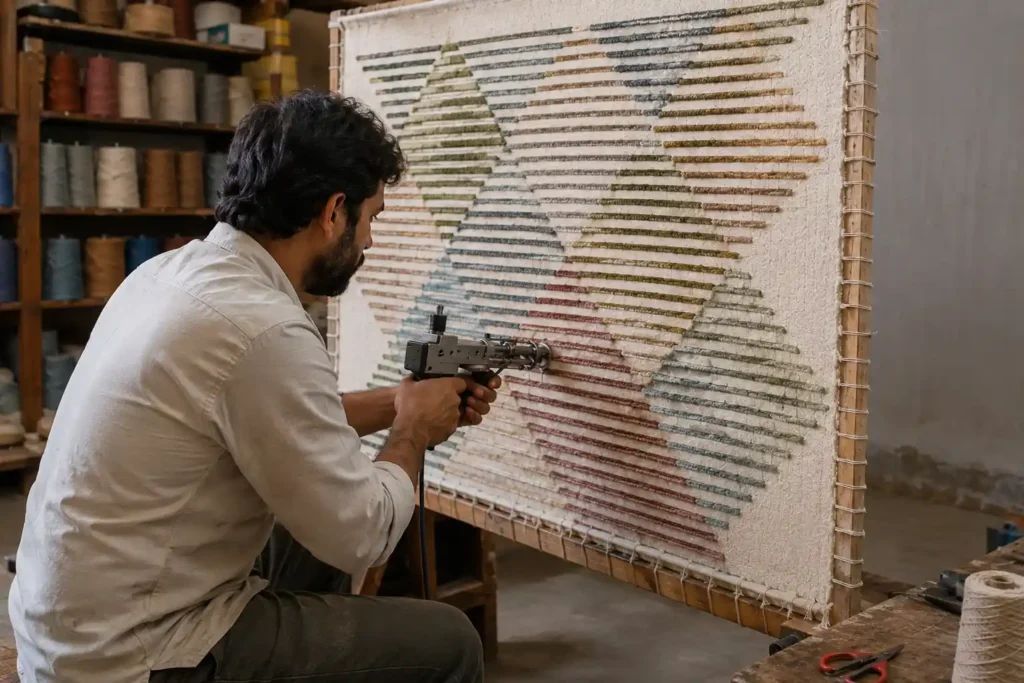
How to Identify a Handmade Rug: 5 Tips Before Buying
Buying a rug feels straightforward until you realise the market is full of different quality imitation pieces sold as the real thing. The price looks right and the pattern looks convincing. But after a few years the pile is flat, the colours have washed out and you are left wondering what went wrong.
At Hasida Rugs Collection, we have been manufacturing and exporting handmade rugs from Bhadohi for over a decade. Behind every beautiful handmade rug are skilled artisans, traditional rug making techniques such as hand-tufting, hand looming, hand knotting and careful attention to detail.
Before you buy, it’s worth learning how to identify a handmade rug so you can choose one that offers lasting quality and genuine craftsmanship.
1. Check the Back of the Rug
On a genuine hand-tufted rug, the back shows a secondary cloth backing, usually cotton canvas, that has been applied by hand over the tufted yarn. Look closely and you will notice slight, natural unevenness in the backing texture because it was pressed and finished by a person, not stamped out by a machine.
On a real handloom rug, the back mirrors the front almost exactly. You will see the weave structure clearly, warp and weft threads interlacing row by row, built up slowly by hand on the loom.
Facts: A back that shows real texture, whether it’s a hand-applied canvas or a visible woven structure, tells you the rug was built by hand, one row and one motif at a time.
2. Abrash: The Sign Most Buyers Miss Completely
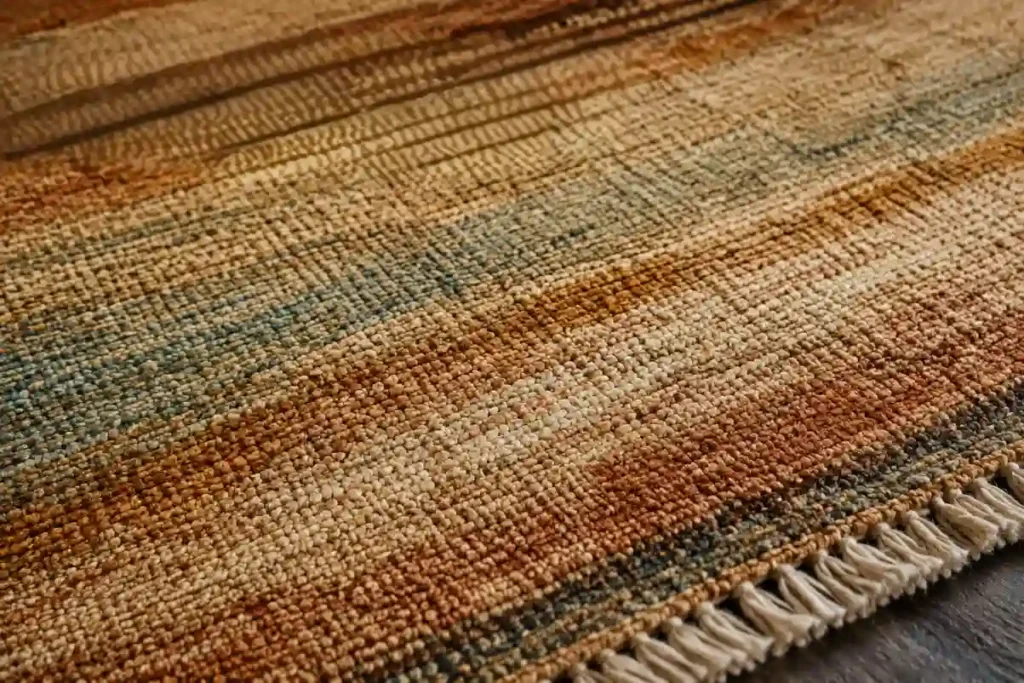
Abrash is the natural variation in colour that appears across the surface of a handmade rug. A slightly deeper indigo in one section, a warmer blue a few rows later, subtle bands of variation running through a field of red or green rug.
It happens because our weavers dye wool in small batches. Even with the same recipe, no two batches come out exactly identical. As the rug grows row by row on the loom, those small dye variations become visible across the surface. The result is abrash.
Facts: Collectors and interior designers who know rugs specifically look for abrash. It is not a flaw. It is a sign of authentic craft and the reason antique handmade area rugs develop a depth and warmth that machine pieces can never replicate.
3. Look at the Colours Carefully
Handmade wool rugs or handmade carpets can be coloured using natural dyes, for example, plant-based, mineral-based and other sources that have been used in the Bhadohi weaving tradition for generations. Madder root gives warm reds and oranges. Indigo produces the deep blues. Pomegranate and turmeric create soft golden yellows.
This doesn’t mean that no chemical dyes are using it depends on the requirements of design and colors but yes, information about the dyes can be verified from the label on the rug.
Natural dyes can produce colours with a softer, more varied appearance, but the exact look depends on the dye source, fibre, dyeing process and finishing. Handmade rugs may also show subtle variations in colour, which can add to their character.
Facts: Abrash refers to subtle variations in colour or tone that can appear across a handmade rug. It is often associated with changes in dye batches, yarn or dyeing conditions and is particularly noticeable in some traditionally dyed rugs. However, abrash alone does not prove that a rug has been naturally dyed.
The fringe on a handmade rug is not just for decoration. It is a structural element.
In genuine handmade area rugs, the fringe is formed by the warp threads, the vertical foundation threads that run the length of the rug and hold every knot in place. When weaving is complete, these threads extend beyond the pile and become the fringe.
A perfectly symmetrical rug with identical borders, flawless pattern repeats and zero variation may not a handmade rug. Machines can create precise symmetry throughout the rug but artisans working on large handmade rugs over weeks and that is exactly what makes the result valuable and handcrafted.
Experienced rug buyers, interior designers and collectors know to look for these marks. They are the confirmation that every row was placed by a person making decisions, not a program executing instructions.
Facts: The more you look at genuine handmade rugs, the more you appreciate what those small variations actually represent.
|
Features |
Handmade Rugs |
Machine Made Rugs |
|
Back appearance |
Knots, backing or weave visible, naturally slight variation |
Flat, uniform, often with applied backing |
|
Fringe |
Structural extension of foundation threads |
Sewn or glued on separately |
|
Pattern |
Slight natural variation across the piece |
Mechanically perfect, uniform throughout |
|
Fibre |
Natural fibre such as wool, silk, cotton |
Often synthetic like polypropylene, nylon |
|
Price |
Higher upfront, lower cost over time |
Lower upfront, higher long-term replacement cost |
Why Handmade Rugs Cost More than Machine-Made Rugs
Once you understand what goes into a genuine handmade rug, the pricing becomes straightforward rather than surprising.
A single hand-tufted rug can take skilled artisans several days to a few weeks to complete, depending on its size and design complexity. The abrash you see across the surface is the record of that process, batch by batch, row by row.
A quality handmade rug becomes softer with use and it continues to settle over time. The colours develop character and the structure remains sound because the foundation is genuine.
Factories can copy the look but they cannot copy the art and soul of skilled artisans.
Ready to Find a Rug That is Genuinely Worth It
Now that you know the five time saving tips the flipping it over, the abrash, the natural dyes, the structural fringe and the honest imperfections you can shop with confidence rather than guesswork.
Whether you are sourcing handmade area rugs for a residential project, looking for handmade wool rugs for a hospitality specification or exploring hand-tufted rugs or handloom rugs for wholesale import, the construction standards are the same. The signs do not change.
Explore our handmade rug collection at Hasida Rugs Collection or get in touch directly to discuss your requirements. Every rug we make carries the story of the hands that built it and those signs we described above are visible in every single one.
Frequently Asked Questions
Q1. How can you identify a handmade rug?
A. Check the rug’s knots, backing, slight irregularities, natural materials and craftsmanship to distinguish handmade rugs from mass-produced alternatives.
Q2. How do you identify a good quality rug?
A. A good quality rug is made from durable natural fibres, has a dense weave, even finishing, strong edges and skilled craftsmanship for long-lasting performance.
Q3. What is the difference between a handmade rug and a machine-made rug?
A. Handmade rugs are crafted by artisans, while machine-made rugs use automated processes, creating differences in craftsmanship, texture, durability and uniqueness.
Q4. What should you avoid when buying a carpet?
A. Avoid buying carpets without checking the material, construction, backing and quality. Always choose a rug that suits your space, lifestyle and maintenance needs.
Q5. What type of rug material is best?
A. As such no single best rug material, but yes wool is considered one of the popular choices for any rug because of its durability, softness and natural insulation, making it ideal for long-term use.
Disclaimer
The information in this blog is provided for general informational purposes only. It is not intended to make definitive claims about rug authenticity, quality, materials or construction. Rug characteristics may vary by manufacturing technique and professional evaluation may be required for accurate identification.