
What to Inspect on a Rug Strike-Off Before Approving Bulk Production
There is a moment in every rug order when everything either goes right or starts to go very wrong and that moment is called the strike-off approval.
If you approve a rug strike-off too quickly without checking it properly, you may end up with bulk rugs that do not match your original design. Colours may look different, the pile quality may vary and patterns may appear uneven. These issues are often hard to notice in photographs but become very obvious once the rugs are produced in large quantities.
This guide is written for retailers, wholesale rug buyers, interior designers and trade importers who commission handmade rugs and need a clear, methodical framework for evaluating a strike-off before giving bulk production the green light.

What Is a Rug Strike-Off
A rug strike-off is a pre-production sample made by the manufacturer to your exact specification before the full bulk order goes into production. It is the physical translation of your brief into an actual woven piece and it is your only opportunity to verify that what you asked for and what the manufacturer has interpreted are the same thing.
Why It Matters More Than Most Buyers Realise
Strike-offs are standard practice in quality handmade rug manufacturing. Any reputable rug supplier will produce one before committing weaver time and materials to a full production run. If a manufacturer is pushing you to approve an order without a physical strike-off that is itself a significant red flag.
Why Getting the Strike-Off Wrong Is the Most Expensive Mistake
The cost of getting a strike-off approval wrong scales directly with the size of the order. A 50-piece bulk order of rugs that come back in the wrong colour way or with pile height inconsistencies represents a significant financial loss and a project timeline disaster. Corrections at the production stage cost many times more than corrections at the strike-off stage and in some cases the error cannot be corrected at all.
Time spent thoroughly inspecting a rug sample before approval is not perfectionism. It is basic commercial risk management.
A strike-off should always be completed and approved before bulk production begins. In a well-managed production timeline, the sequence runs:
design brief confirmed
- Materials sourced for rug production
- Initial strike-off sample is created
- Sample checked for quality standards
- Design approved or revision requested
- Full-scale rug production process begins
The strike-off stage typically adds two to four weeks to the overall timeline for handmade rugs depending on the complexity of the design and the number of revision rounds required.
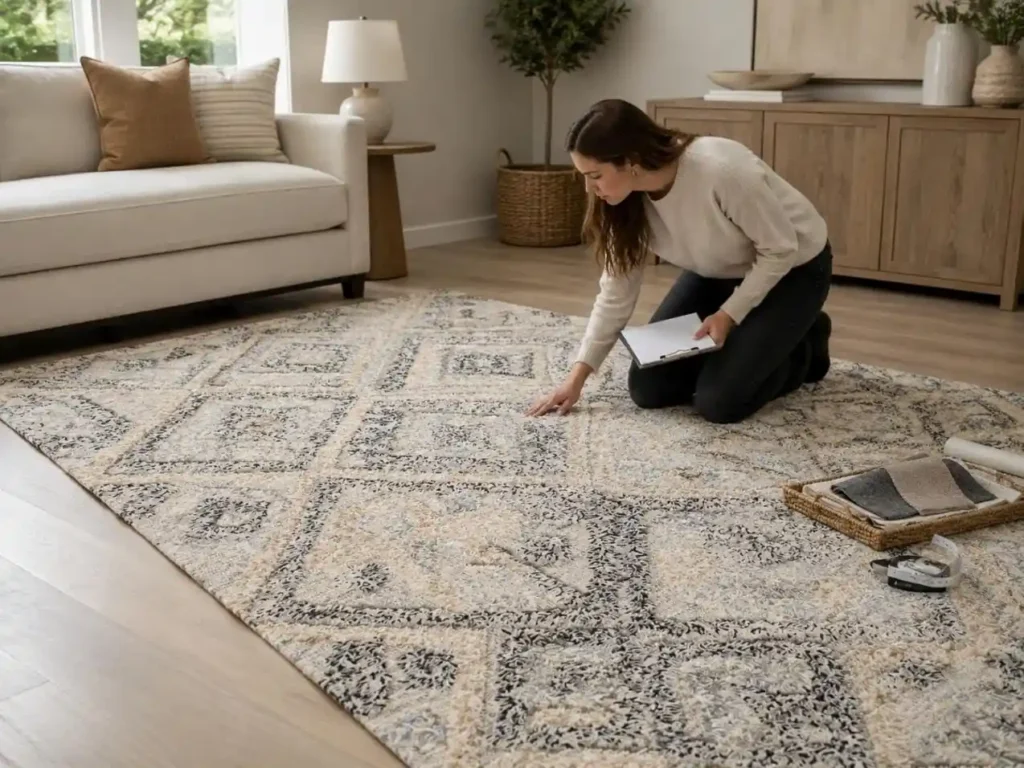
If your original brief included Pantone references, use a calibrated Pantone colour guide to compare directly. If it included a physical swatch or fabric reference hold it flat against the rug surface rather than comparing from memory or from a screen image.

Colour in a woven textile behaves differently from colour on a painted surface or a digital render. Pile direction affects how light reflects off the rug surface and the same colour can read darker or lighter depending on the angle you view it from. A colour that looks perfect in the manufacturer’s sample room may read differently against the flooring, furniture and wall tones of the final installation environment.
Pile Quality and Construction Checks on a Rug Sample
Pile height consistency is one of the clearest indicators of manufacturing quality in a handmade rug. Run your hand across the strike-off in multiple directions and across multiple sections of the piece. The pile should feel uniform throughout. Any areas that feel noticeably higher, lower or flatter than the surrounding surface indicate inconsistent knotting tension during weaving.
How to Verify Knot Density
Knot density is specified in knots per square inch for hand-knotted rugs and should be clearly stated in your original rug order specification. To verify knot density on a strike-off count the knots visible on the reverse of the rug across a one-inch square in multiple locations. The count should match the specification consistently across the piece.
How to Check Pile Density and Recovery
Pile density refers to how tightly packed the pile fibres are and directly affects how the rug wears under foot traffic. A correctly dense pile will spring back after compression. Press your palm into the surface and release. The pile should recover fully within a few seconds. Slow recovery or permanent compression marks indicate insufficient pile density for the intended use.
How to check Surface Texture and Hand Feel
The surface of a quality handmade rug, such as handtufted rug, should feel consistent in texture throughout. Run your hand slowly across the entire strike-off noting any areas that feel rougher, coarser or softer than the surrounding surface. Inconsistencies in hand feel typically indicate variations in the yarn quality or dyeing process across different sections of the piece.
Pattern, Design and Dimension Accuracy in Rug Strike-Off Approval
Before bulk production begins, the strike-off confirms that the rug design, colour and quality match the original specifications.
How to Check Pattern Repeat Accuracy
Check that motifs appear in the correct position relative to each other, that the repeat scale matches the specification and that no elements have been simplified, enlarged or altered during the interpretation process.
Border Straightness and Edge Finish
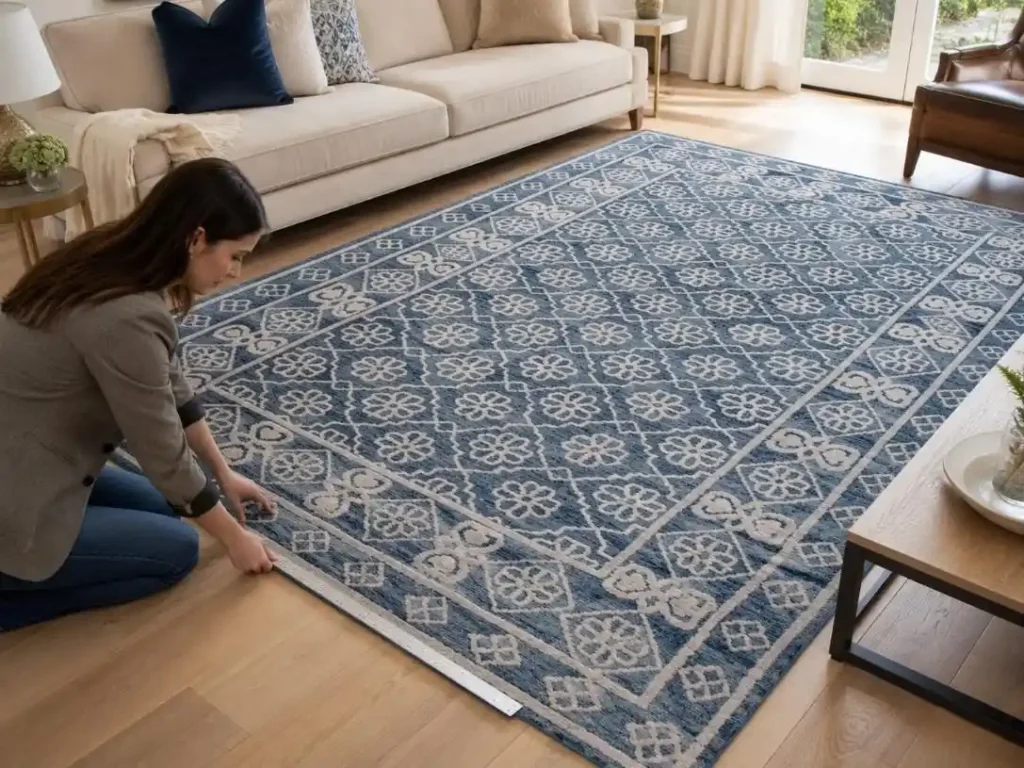
Borders and edges reveal manufacturing precision more clearly than any other part of a rug. Use a straight ruler or tape measure to check that border lines run perfectly straight and parallel to the rug edge throughout their length. Any drift or waviness in a borderline that is a few centimetres wide on the strike-off will be significantly more visible on a finished rug at full size.
Checking Dimensional Accuracy
Measure the strike-off in both directions and compare against the specified dimensions. Handmade rugs have an accepted tolerance of approximately one to two percent in each dimension due to the nature of hand weaving.
Motif Placement and Symmetry
For rugs with central medallions, corner motifs or complex symmetrical designs check the placement and symmetry of every major design element carefully. Fold the strike-off diagonally to check for basic symmetry if the design calls for it.
Fibre and Dye Quality Inspection Before Bulk Rug Production
Before bulk production begins, every fibre and every dye batch goes through a thorough quality inspection that sets the standard for everything that follows. The quality of what goes in at the start is what determines the quality of what comes out at the end.
How to Verify the Fibre
The simplest field test for wool versus synthetic is a burn test. Pull a small number of fibres from an inconspicuous edge of the strike-off and burn them. Wool burns slowly, smells like burnt hair, produces a crushable ash and self-extinguishes. Synthetic fibres melt, produce black smoke and leave a hard bead rather than ash.
Natural Dye vs Synthetic Dye
Natural dyes produce colours with a characteristic depth and slight tonal variation that gives handmade rugs their distinctive warmth and complexity. Synthetic dyes tend to produce flatter, more uniform colour. If natural dyes were specified, ask for a dye certificate since visual inspection alone cannot confirm dye authenticity.
Backing, Finishing and Structural Integrity Checks
The finishing stage of a handmade rug is where craftsmanship either holds together or falls short and a thorough structural integrity check at this point ensures that every rug leaving the workshop is built to last as well as it looks.
How to Inspect the Backing Material
On a hand-knotted rug the individual knots should be clearly visible, evenly spaced and consistent in size. The foundation warp and weft threads should run cleanly and evenly without distortion. The backing should feel firm and stable without being stiff or brittle. Any areas where the foundation structure feels weak or where threads show signs of distortion indicate structural quality issues.
How to Give Structured Feedback on a Rug Strike-Off
Clear and specific feedback on a strike-off sample saves time and avoids costly mistakes. Note exactly what is working, describe pattern, colour and dimension issues precisely and always put feedback in writing so nothing is missed between the review and the workshop.
How Hasida Rugs Collection Handles the Strike-Off
Looking for a rug supplier who makes the strike-off and approval process straightforward? Hasida Rugs Collection is here to discuss your rug sampling requirements and request a trade buyer consultation. Hasida Rugs Collection provides strike-offs with clear revision timelines before bulk rug production begins.
Frequently Asked Questions
Q1. What is a rug strike-off?
A: A rug strike-off is a pre-production sample used to verify design, colour, material and construction before bulk manufacturing.
Q2. Why is strike-off approval important before bulk production?
A: Strike-off approval helps prevent costly production mistakes related to colour accuracy, pile quality, sizing and pattern consistency.
Q3. How do you check colour accuracy in a rug strike-off?
A: Compare the sample directly with Pantone references or physical swatches under proper lighting conditions for accurate colour evaluation.
Q4. What should buyers inspect in a handmade rug sample?
A: Buyers should inspect pile density, knot quality, dimensions, pattern accuracy, fibre quality, backing and overall finishing details carefully.
Q5. How long does the rug strike-off process take?
A: The strike-off process usually takes two to four weeks depending on rug complexity and the number of revisions required.
Q6. Are Pantone colours always exact in handmade rugs?
A: No, Pantone colours in handmade rugs may vary slightly due to natural fibres, hand-dyeing techniques and lighting differences. Skilled artisans aim for the closest possible match while maintaining the rug’s handmade character.